
Why Cut Matters More Than Carat
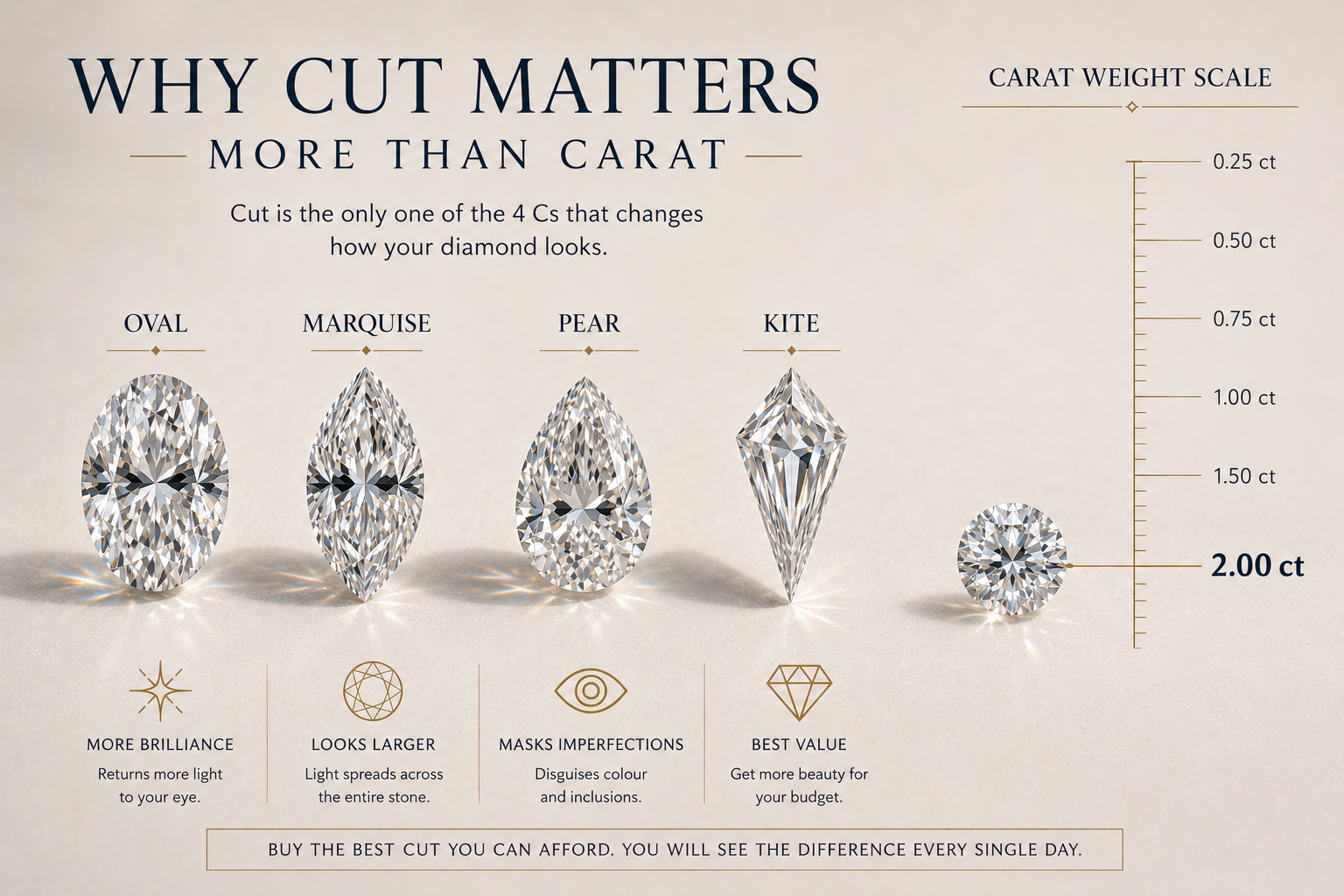
Ask someone about their engagement ring and they will tell you the carat weight. Almost nobody mentions the cut.
This is backwards. Of the four Cs, cut is the only one that changes how the diamond actually looks — and it is the one most often given up to reach a number that sounds good.
What cut actually means
Cut is not the shape. Round, oval, emerald: that is shape. Cut is the quality of the proportions, angles, and finish within that shape.
A diamond is a light machine. Light enters through the top, bounces off the internal facets, and returns to your eye. When the angles are right, nearly all of it comes back — that is brilliance, and the flashes of colour called fire. When the stone is cut too shallow or too deep, light passes through the bottom and is lost. The stone looks glassy, or dark in the middle, or simply dull.
Two diamonds of identical carat, colour and clarity can look like different objects entirely. One is the reason people say a diamond "catches the light across a room". The other is the reason people quietly stop wearing a ring.
Why it gets sacrificed
Because carat is legible and cut is not.
Carat is a number that goes up. It is what gets asked about and what gets compared. Cut is a grade most buyers cannot evaluate by eye in a shop, under lighting designed to make everything look good.
So when a budget will not stretch, cut is what gives. A shopper who wants to say "one and a half carats" will accept a Good cut to get there, and end up with a larger stone that returns less light than a smaller Excellent one would have.
The trade, concretely
Consider a fixed budget. You can buy:
- a 1.20 ct stone with a mediocre cut, or
- a 1.00 ct stone cut to Excellent
The first is 20% heavier. That difference is roughly 0.4 mm of diameter — undetectable unless the two sit side by side on a desk.
The second returns noticeably more light in every ordinary lighting condition: daylight, a restaurant, a lamp-lit room. It looks brighter, whiter, and often larger, because a well-cut stone spreads light across its whole face rather than going dark toward the middle.
You cannot see 0.4 mm. You can absolutely see the difference between a stone that lights up and one that does not.
Cut also compensates for the other Cs
This is the part that makes it the best value in the whole decision.
It masks colour. A well-cut diamond returns so much white light and fire that faint body colour becomes much harder to perceive. An excellently cut G can read whiter than a poorly cut F.
It distracts from inclusions. Strong brilliance makes small inclusions harder to spot, because the eye is following flashes rather than resting on the surface.
It makes a stone look bigger. A well-cut stone's light spreads to the edges; a poorly cut one has a dull centre that visually shrinks it.
So cut quality does not merely compete with the other three specifications. It buys you room to spend less on all of them.
What to actually look for
For round diamonds, look for an Excellent or Ideal cut grade. This is the one shape with a standardised, reliable cut grade — use it.
For fancy shapes — oval, pear, marquise, cushion, emerald — no equivalent overall cut grade exists on most reports. Judge them by eye, and by two specific faults:
- The bow-tie: a dark band across the middle of elongated shapes (oval, pear, marquise). Every one has some. A good stone's is faint; a bad one's is a black stripe that never goes away.
- Uneven shoulders or a lopsided outline. Symmetry is easy to see once you look for it, and impossible to unsee afterwards.
Ignore polish and symmetry grades below the headline cut grade. They matter far less than the proportions, and chasing them is how people spend money on invisible improvements.
The one-sentence version
Buy the best cut you can afford, then let colour, clarity and carat fall where the budget leaves them.
It is the only one of the four you will actually see from across the room — and it is the only one you cannot fix later.