
Lab-Grown vs Natural Diamonds: What the Price Difference Actually Looks Like
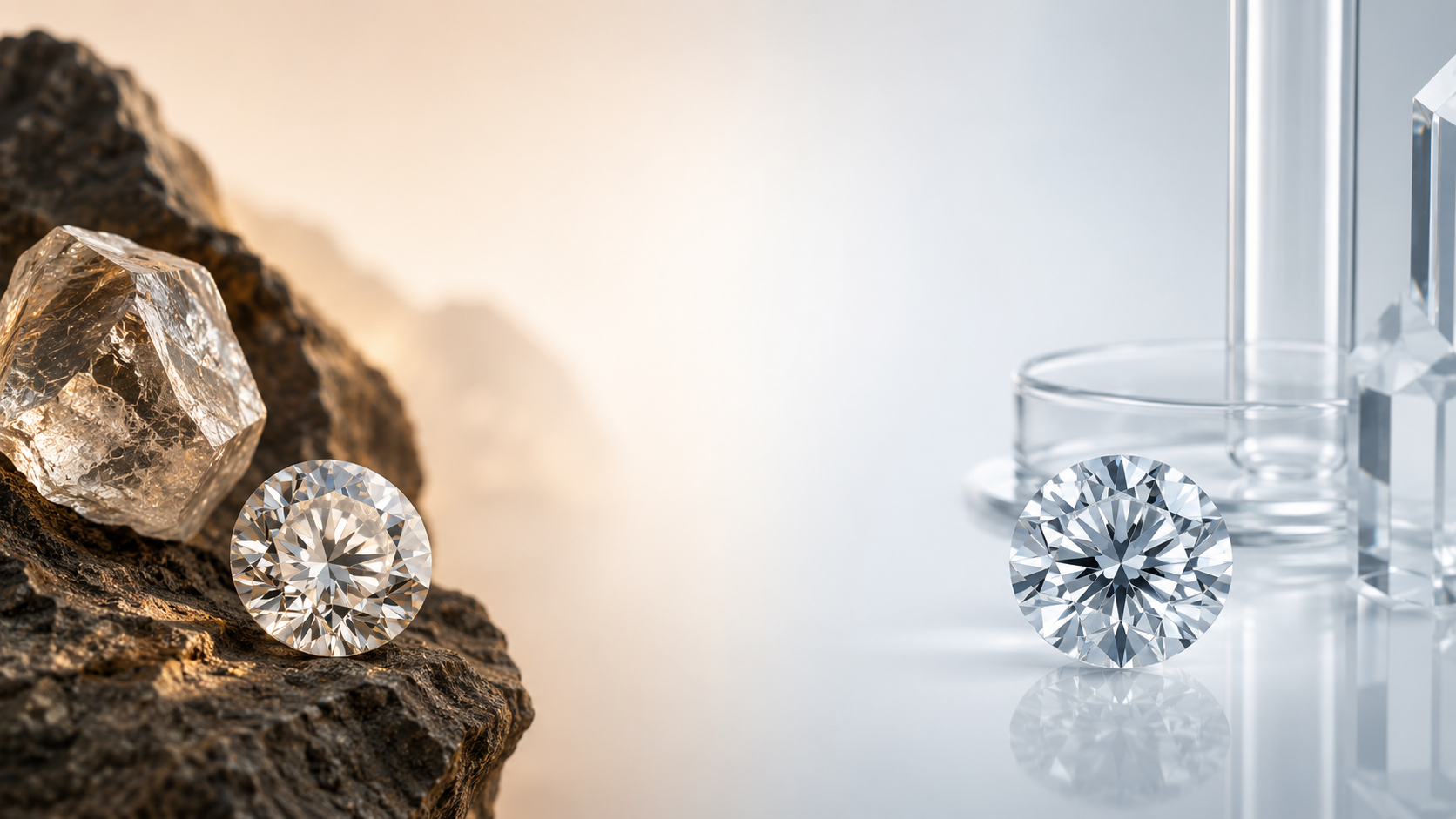
Two diamonds sit side by side. Same round cut, same G colour, same VS1 clarity, same 1.50 carats. One costs about $9,600. The other costs about $280.
Under a loupe, a jeweller cannot tell them apart. Neither can a gemmologist without specialised equipment. They are both crystalline carbon, both a 10 on the Mohs hardness scale, both refracting light in exactly the same way. The difference is that one formed underground over a billion years and the other formed in a reactor over a few weeks.
Whether that difference is worth $9,300 is a real question, and it does not have one right answer. But it does have a shape, and the shape is more interesting than most people expect.
What the price gap actually looks like
Most articles on this subject say lab-grown diamonds cost "30–50% less". That was true several years ago. It is nowhere close to true now.
These are median prices from our own inventory, comparing stones matched on shape, colour and clarity — G colour, VS1 clarity, so the only variable is origin:
| Shape | Carat | Natural | Lab-grown | Lab as % of natural |
|---|---|---|---|---|
| Round | 1.0 ct | $3,375 | $210 | 6% |
| Round | 1.5 ct | $9,609 | $282 | 3% |
| Round | 2.0 ct | $23,219 | $401 | 2% |
| Round | 3.0 ct | $51,586 | $602 | 1% |
| Oval | 1.0 ct | $5,056 | $261 | 5% |
| Oval | 2.0 ct | $28,981 | $458 | 2% |
| Emerald | 1.0 ct | $3,383 | $240 | 7% |
| Emerald | 3.0 ct | $69,071 | $454 | 1% |
Look down the right-hand column rather than across the rows. The discount is not a flat percentage — it widens sharply as the stone gets bigger.
At one carat, a lab diamond costs roughly a fifteenth of its natural twin. At three carats, it costs roughly a hundredth.
Why the gap widens
Natural diamond pricing is steeply non-linear. Large, clean rough is genuinely rare, and price per carat climbs fast with size — a three-carat natural round is not three times a one-carat, it is closer to fifteen times.
Lab growth does not work that way. Growing a larger crystal takes longer and fails more often, so cost does rise — but roughly linearly, not exponentially. Our three-carat lab rounds run about $200 per carat; our one-carat lab rounds run about $210 per carat. Essentially flat.
Two different cost curves, diverging. That produces the single most useful rule in this entire debate:
The larger the stone you want, the more the lab-grown option saves you — and the more you are giving up by choosing natural.
If you want a modest stone, the decision is close to a coin flip on money. If you want a big one, it is a decision about something other than money.
What you are giving up
Let us be direct, because the industry usually is not.
Resale value. A lab-grown diamond has very little. Wholesale lab prices have fallen dramatically as production capacity has grown, and there is no reason to expect that to reverse — manufacturing gets cheaper, not more expensive. A lab diamond bought today will likely be worth less in five years, in a market where new stones cost less than yours did.
But natural is not an investment either. This is the part that gets left out. A natural diamond also sells for a fraction of its retail price on the secondary market, because you are selling a used stone into a trade that buys at wholesale. "Holds its value better than lab" is true. "Holds its value" is not.
If your reasoning is financial, the honest version is: neither of these is an asset. One is a large purchase that depreciates. The other is a much smaller purchase that depreciates faster in percentage terms and by far less in dollars.
Rarity, and whether it means anything to you. A natural diamond is a geological object with a history. Some people care about that a great deal, and that is a legitimate reason to spend the money — the same reason people buy original artwork rather than a perfect print. Others find the distinction meaningless once the stones are optically identical. Neither position is wrong, and nobody selling you a diamond should tell you which one to hold.
What you are not giving up
Appearance. There is no visual difference. A lab diamond is not a simulant — it is not cubic zirconia or moissanite, which have different optical properties and genuinely do look different. It is a diamond.
Durability. Identical. Both are the hardest natural material known. Both will outlast you.
Certification. Lab-grown stones are graded by the same laboratories — IGI, GIA — on the same cut, colour and clarity scales. A lab diamond's report is not a lesser document.
Selection. In practice, often better. In our own inventory at three carats, round, G/VS1, we typically stock a few dozen natural stones against several hundred lab. If you want something specific at a large size, the lab market will usually have it and the natural market may not.
So which should you buy?
A framework rather than an answer:
Choose lab-grown if the size of the stone matters more to you than its origin; if you would rather spend the difference on the setting, the honeymoon, or nothing at all; or if you want a stone above two carats that would otherwise be out of reach. This is most people, and there is no shame in it.
Choose natural if the geological origin genuinely matters to you and you have priced it honestly as a preference rather than an investment; or if you expect the piece to be handed down and want it to be a natural stone when it is.
A third option most people miss: buy a smaller natural stone rather than a larger lab one. A well-cut one-carat natural in a beautiful setting will outshine a poorly-cut three-carat anything. Cut quality affects how a diamond actually looks far more than the last half-carat of size does — and it is the specification most often sacrificed to hit a carat number.
The question worth asking instead
"Lab or natural" is the question people arrive with. It is rarely the one that determines whether they end up happy.
The stone's cut governs how it looks in a room. The setting governs how it wears for the next forty years. The shape governs whether it still looks like you in a decade. Origin governs the price and, for some people, the meaning.
Get the first three right and either origin will make something you love. Get them wrong and no origin will save it.
If you want help thinking it through against real stones and real prices rather than in the abstract, that is what we are here for.