
How to Care for Fine Jewelry
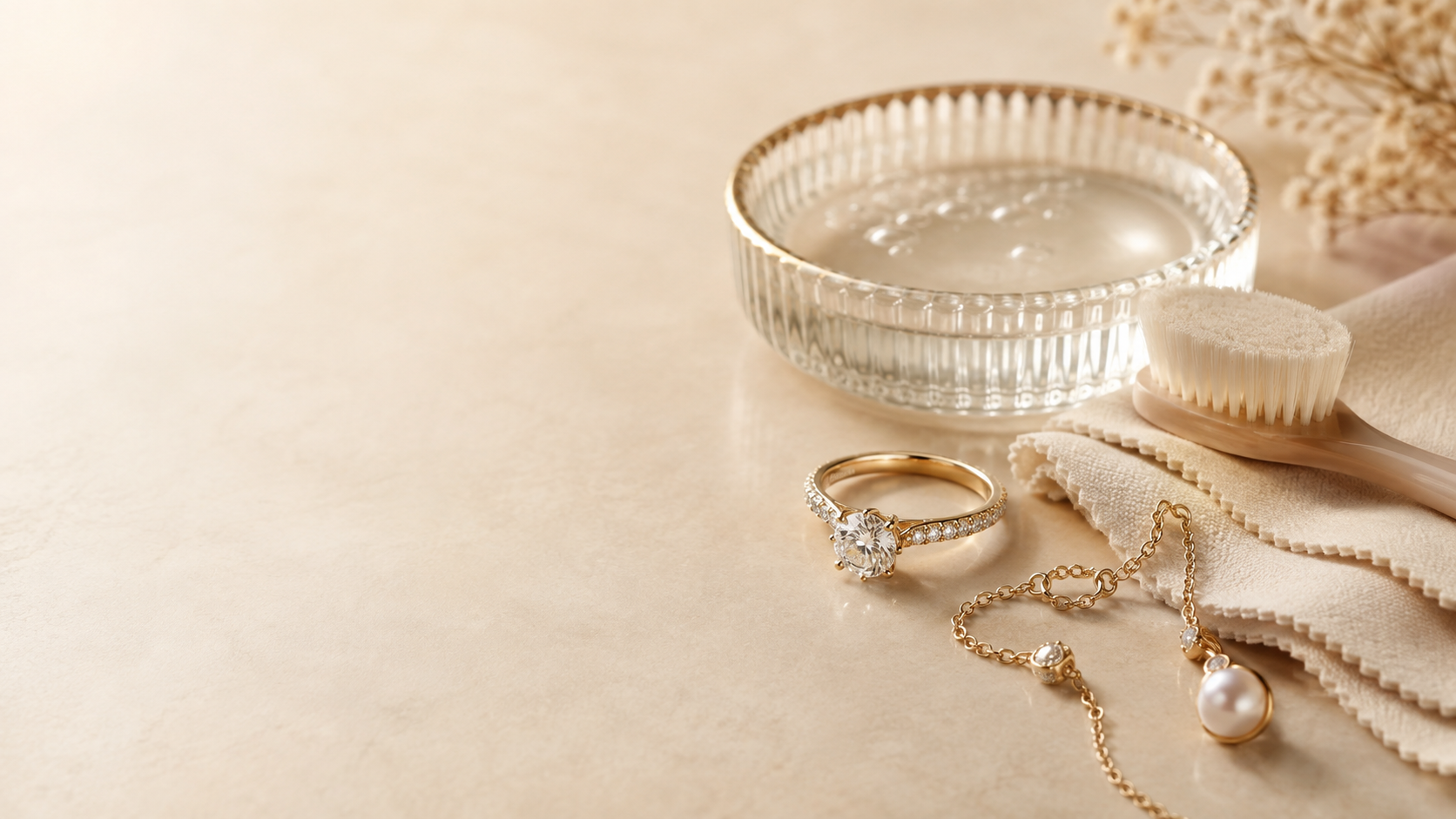
Fine jewelry does not need much. It needs the right small things, done occasionally, and a few things not done at all.
Most damage we see is not wear. It is one avoidable event.
Cleaning, at home, in five minutes
Warm water, a drop of ordinary dish soap, and a soft toothbrush. Soak for ten minutes, brush gently — paying attention to the underside of the stone, where the dulling happens — rinse, and dry with a lint-free cloth.
That is genuinely it, for diamonds, sapphires and rubies in gold or platinum.
Do this more often than you think. The film that dulls a diamond is skin oil, hand cream and soap residue, and it builds up underneath where you cannot see it. A stone that has "lost its sparkle" has almost always just got dirty. People are frequently astonished at how much of it comes back.
Once a month is plenty. Before an occasion is ideal.
What not to use
Never chlorine bleach. It attacks the alloys in gold, and over time causes stress cracks in the metal around your stone. This is how a prong fails.
Skip ultrasonic cleaners unless you know exactly what your piece is. They are excellent for a plain diamond solitaire and genuinely dangerous for a good deal else — see below.
No toothpaste, despite the folk advice. It is abrasive and will scratch softer stones and polished gold.
The stones that need different rules
Hardness is not the same as toughness, and several beautiful stones are much more fragile than their price suggests.
Emeralds are almost always oiled or resin-treated to fill natural fissures. Ultrasonic cleaning and hot water strip that treatment out, and the stone can visibly change. Warm water and soap, briefly, by hand — never an ultrasonic.
Opals and pearls are porous and contain water. Never soak them; never use an ultrasonic. Wipe pearls with a damp cloth after wearing, because perfume and sweat degrade nacre over time.
Tanzanite has perfect cleavage — it will split from a sharp knock in the wrong direction despite being reasonably hard. It is a beautiful evening stone and a poor daily ring.
Pearls go on last and come off first. After perfume, hairspray and lotion; before anything else.
The two habits that prevent most damage
Take rings off for the gym. Not for cleaning, not for gardening — for lifting. Gripping a loaded barbell exerts enough force to bend a band out of round, and a ring that is no longer round no longer holds its stone properly. This is the single most common cause of damage we see in otherwise well-treated rings.
Store pieces separately. A diamond is a 10 on the Mohs scale, which means it scratches everything else in the box, including your other diamonds. Soft pouches, or a lined box with compartments. Not a shared dish.
Have the prongs checked once a year
This is the one thing worth a professional's eyes, and it takes minutes.
Prongs wear down. It happens gradually, invisibly, over years of ordinary contact — and the failure mode is a stone falling out of a ring you were wearing perfectly normally. A jeweller can see thinning prongs long before they let go, and re-tipping them is a minor job. Replacing a lost centre stone is not.
A test you can do today: hold the ring next to your ear and tap it gently with a fingertip. A secure stone is silent. A faint rattle means it is loose — stop wearing it and have it looked at.
When something goes wrong
Do not attempt a repair with adhesive. Every jeweller has stories about glue, and none of them end well — it fails, it discolours, and it makes the eventual proper repair harder and more expensive.
If a stone is loose, stop wearing the piece immediately. The cost of a tightened prong and the cost of a lost diamond are not remotely comparable.
The short version
Wash it in soapy water more often than you do. Keep bleach away from it. Take your rings off before you lift anything heavy. Store pieces so they cannot touch. Have the prongs checked once a year.
Do those five things and a well-made piece will outlast you — which is rather the point of buying one.